

How It Works
1. Install
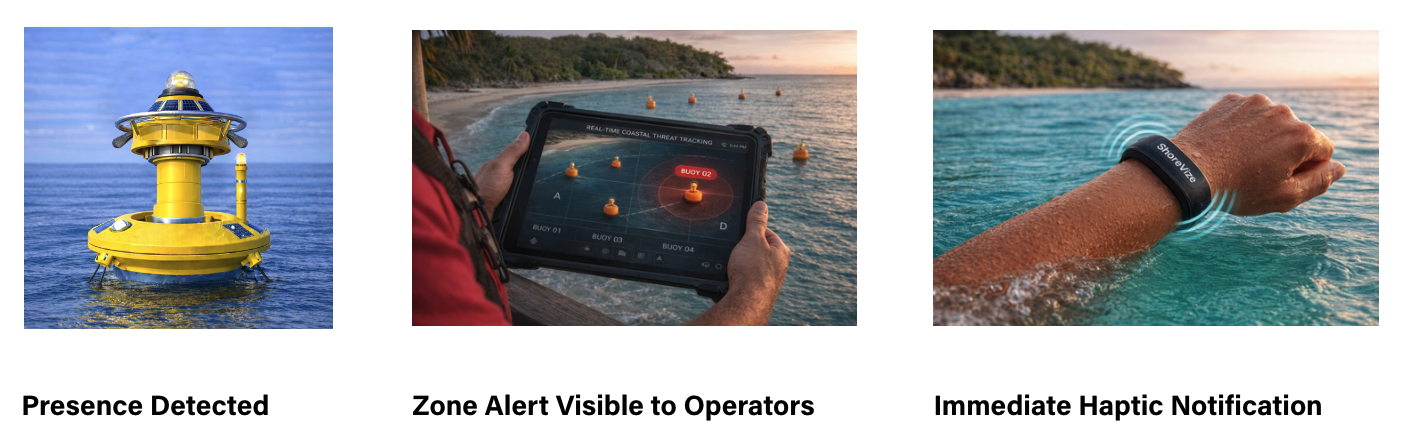
Permanent seabed anchor stations are installed within defined coastal monitoring zones. These stations establish fixed locations for buoy deployment while minimizing visible surface infrastructure.
2. Monitor
Each buoy operates as an independent detection node secured to its anchor station. Multiple nodes form an offshore sensing array with overlapping detection zones that continuously monitor activity within the protected swim corridor.
3. Alert
When a buoy detects large marine presence within its monitoring radius, the event is transmitted to a shore-based monitoring interface. Lifeguards and coastal operators receive immediate zone-specific alerts that support rapid operational decisions.
Distributed Coastal Monitoring Infrastructure
Managed beaches rely on lifeguard patrols, aerial observation, and tag-based tracking programs to monitor marine wildlife activity. These methods provide limited and intermittent visibility across the water column and often detect animals only after they are already near swimmers.
Most existing monitoring tools are reactive. Aircraft patrols occur periodically, tagging programs only track previously tagged animals, and visual observation is constrained by distance, water clarity, and environmental conditions. As a result, coastal operators frequently face uncertainty when making decisions about swimmer safety.
Precautionary beach closures and delayed response times create operational disruption for municipalities, lifeguards, and coastal tourism operators.
The challenge is not a lack of information.
The challenge is the absence of continuous awareness offshore.
The ShoreVize Solution
ShoreVize installs fixed seabed anchor stations that support a distributed network of intelligent monitoring buoys positioned offshore.
Each buoy operates as an independent detection node within a coordinated coastal array. Together, these nodes create overlapping monitoring zones that provide continuous presence detection across designated swim corridors.
Rather than attempting to classify species or track individual animals, the system focuses on identifying large marine presence within defined areas and transmitting clear, real-time alerts to shore.
This transforms coastal safety from reactive response to proactive situational awareness.
System Characteristics
• Fixed offshore monitoring stations
• Distributed buoy detection network
• Continuous zone-based sensing coverage
• Designed for coastal safety infrastructure
The objective is not species classification.
The objective is real-time coastal zone awareness.